Quillov’s Creations › Cobalt Tomes › Unbound Novels › Proof Load
Book
Proof Load
Current Edit
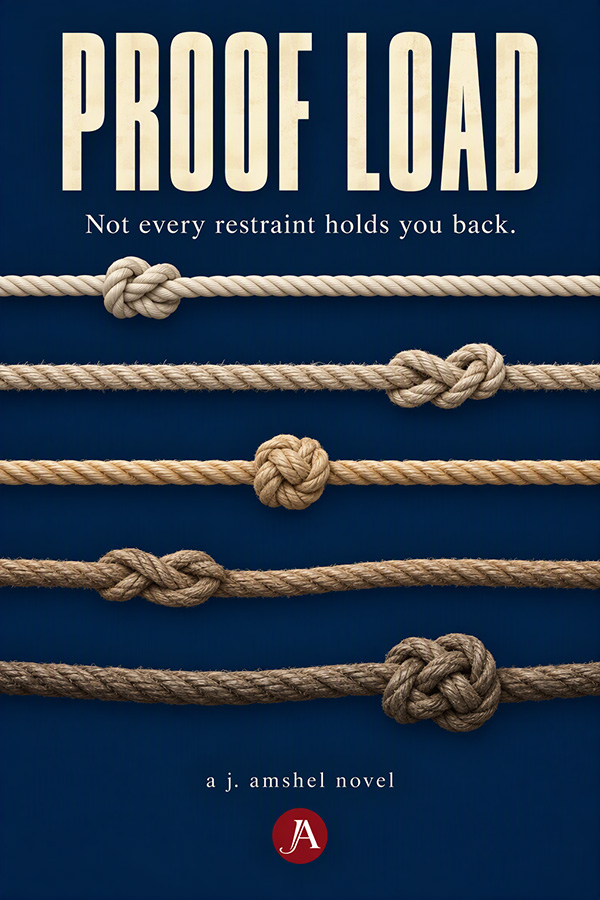
You can spend your whole life getting tangled in the wrong kind of knots.
Raquel holds everything: the room, the client, the campaign. Her marriage. She's been holding it all together for so long that she finally calls on a twelve-year-old promise her wife made and picks up a stranger in a Las Vegas bar.
He gives her the only room she has ever been in where she owes nothing to anyone.
Then Raquel discovers her company has been recording how she works, training a machine on her reasoning so that eventually they won't need her. She tells nobody.
Ender isn't what she thinks. He's a professional who has spent two years saving for an escape, and the night that saves Raquel begins to cost him that exit.
Then her wife, certain that whatever happened in that room can be learned, goes looking for a professional who can show her what changed Raquel. She finds the same man.
Told in six voices, Proof Load is an upmarket novel about intimacy as labor, the parts of a person that can be recorded and the parts that can't, and what it costs to finally put everything down.
One: Slip Knot · Raquel
The room smells like lavender and tea tree oil and sex. Mostly sex. Which is weird because that was the one thing we didn’t do.
I'm face down in his pillow, and I cannot lift my head, and I don't want to. My mouth is going anyway. It hasn't stopped since he untied me.
“—and it isn't nylon,” I'm telling the pillow. “It's got a nap on it. Like a cat's tongue. And it smells like a barn but a clean one, and I keep thinking, what is that, because I looked at it in the closet and I thought, that's twine. That's what you tie roast with. And then it was on me, and it was—”
He hums. A low sound in his chest I can feel through his fingers. He does not tell me what it's called.
He has my wrist in both hands, aloe cold on the rope burns, his thumbs moving in slow circles like he has nowhere to be until Tuesday.
His thumb crosses the pale stripe on my finger.
Just skin. A little band of winter on a tan hand. He doesn't stop, doesn't slow, maybe doesn't even notice, and I close my eyes and keep talking, faster now.
“I came out for a drink. That's it, that's the whole plan. Was the plan. I want you to know that. Four hours of not being at home. Maybe be with someone. Maybe not.” The circles keep going. “I've read things. Obviously, I've read things, everyone's read things, and it's all a woman in a corset and somebody saying good girl in a voice, and there's a whip, and it's lit. It's lit like a perfume commercial. And you had a lamp on. You had a lamp on like we were doing taxes.”
The oil goes tacky under his thumbs, and he adds more without being asked.
“And then you asked what I'd eaten.” I laugh into the cotton. “That's the part I keep—you asked what I'd eaten and when, and you made me say the time out loud, and I thought, fine, this is the form, this is the part where I initial something. And it kept going. I said the thing about my shoulder. And then four questions later you asked about my shoulder again, and I said, I told you that, and you said—”
“You did.”
“You said you did. Like that was an answer.”
He doesn't offer me one now either.
There is a closet in this room, and it's open about six inches. I'm the one who opened it earlier, when he was in the kitchen. I opened a stranger's closet like an absolute lunatic, and there was rope hanging in it. Not random piles. Hanging on pegs. Neat. Eight or nine lengths of it, dark and pale and dark, and a thing at the end on a hook that I have no word for at all. I made a noise and shut the door.
I counted, because I count. I could not have told you what the number meant. My stomach could, and it made the noise for me.
And the thought comes in from the side, the way the other one keeps coming in from the side, and I have to ask him. I have to, right? Yes. I have to.
“Can I ask you something?”
“Mm.”
“What's the oil?”
“Arnica,” he says. “The other one's aloe.”
He pours more into his palms and rubs them together and lays them flat on the backs of my thighs. The skin there is still shouting. My hips jerk into the sheets like something on a wire. He waits until that stops before he does anything else.
“There's no word for it,” I tell him. “That's the thing that's actually bothering me. Somewhere in the middle of it I went somewhere, and it was a whole country, and I don't have the vocabulary. I hate not having the vocabulary. Words are the job. Words are what I am, and I can't deck this. I couldn't put this in a room. I'd stand up in front of nine people and say—”
The thought falls off a cliff. I let it go.
His knees press against my ribs as he moves up. The little amber bottle pops open. That sharp clean hospital-forest smell deepens, and then his thumbs find the base of my neck, where every deadline I have ever survived lives in the muscle. He’s just putting me back together. Piece by piece, like he’ll be graded on it.
And then the ache changes address.
Higher. Behind the sternum, a soft hollow thing blooming up into my throat, and it has nothing to do with his hands, and it will not explain itself. Three people have put their hands on me this year, and two of them wanted a signature. My wi—
The oil tingles, cool and burning at once, and with the crush of his palms behind it.
The heat comes down off my shoulders without asking my permission and pools low in my belly. I know what it wants to be, and that can't be right. Not at this hour, not from this. I thought, during, maybe. Then my thighs start to tremble, and deep inside me the pool begins to pulse, quiet and rhythmic, a slow contraction rolling through all that wet. The stripes on my thighs sting in time with it. The weights are off, but my nipples still know where they were.
I come. Silently. From a shoulder rub.
What. The. Fuck.
I lie very still with my eyes wide against the dark of the pillow, heart going like a bird in a fist. Maybe he didn't see that. Did he see that? Is that normal? Am I?
The buzz pulls my head off the pillow. On the floor, in the puddle of my slacks, my phone lights up. 12:47. The lock screen glows for three seconds—two women squinting into the sun on a beach somewhere warm—and goes dark.
I keep my mouth shut for the first time all night.
* * *
My slacks are still in a puddle by the bed, and getting into them takes three tries because my legs belong to somebody else now. The bra I don't even attempt. It was too tight at seven o'clock, and whatever has happened to my body since then, it has not gotten smaller. I ball the lace into my purse like stolen evidence.
He's waiting by the door. Not hovering. Just there, the way furniture is there, and he holds out his phone.
“I need your number.”
“That's—” Presumptuous. Fast. Thrilling. “Why?”
“Aftercare doesn't end when you leave. In about a day, day and a half, your body is going to send you a bill for tonight. You'll feel flat. Maybe weepy, maybe angry. All at nothing. That's chemistry, not you. I check in. Until it passes.”
He says it the way a pharmacist says, take with food. And I am desperate to be in my car, alone, where I can lay the whole night out on the dash and audit it, so I don't argue. I just touch my phone to his and the little chime sounds and the contact card blooms on my screen.
Ender.
That's it. No last name. No photo. No company, no title, nothing to optimize.
“Ender,” I say. “Just—Ender?”
Fourteen years in marketing and my whole body knows what I'm looking at. That's not a name, that's a brand. Nobody's mother stood on a porch calling that in for dinner.
He smirks. It's the first unprofessional thing his face has done all night.
“Maybe I'll tell you the story next time.”
Next time goes through me like a struck bell. Every ache he installed in me tonight rings at once—the stripes on my wrists, the burn down my thighs, and higher, sharper: my nipples go hard against the silk of my top, instantly, obviously, no bra between me and the porch light.
He looks down. Takes his time about it. Looks back up into my eyes.
“If you're interested in the story,” he says. “Or a next time. Watch for my messages.”
And he closes the door. He closes the door. On me.
I stand there. The porch light hums. Somewhere in my purse my phone holds a one-word man, and somewhere behind that door the one-word man holds—I don't finish that sentence.
I walk to my car. Halfway across the street I look down, and they're still at it, both of them, pressing out of the silk like they have an announcement, and I actually press my palms flat against them, right there under the streetlight, and start patting them down like a fire I can smother.
“Stop it,” I whisper. “Stop. You two do not get to give statements to the press. Everything tonight was off the record, and you are both—” a car passes; I drop my hands and stand very straight—“wildly off message.”
They do not care. They have never cared about the campaign.
The car is where I left it. I get in and sit with the key in my hand and don't put them anywhere. There's a stripe on the inside of my wrist I can see by the dome light. I press it with my thumb, and it goes white, and I count, and it comes back.
Next time, the bell says.
Two: Binding Knots · Raquel
The coffee is cold. I’ve been staring at it for an hour, maybe more. My thumb is wrapped around my wrist, right where the rope burned a stripe into the skin. If I press down on it, hard, and let go, the pale band goes white as a rubber eraser. Sometimes it stays that way for ten, fifteen seconds before the blood returns and the ring reappears. I do it over. And over. Thumbprint. Release. Count to ten. The urge to take a picture of it, to send it to someone, pulses in my other wrist.
But there is nobody to send it to.
Vivian is not a morning person, which means I have the whole kitchen and two thousand square feet of cold tile to myself. The house smells like the air conditioner filter. I can hear the vent rattle, the fridge groan, the neighbor’s yard guys. If I breathe shallow and keep my eyes locked on the mug...then I don’t have to process what else is happening inside my own body.
At 7:14, the first text comes in.
Ender: Water before coffee. 16 oz minimum.
The text sits on my phone’s lock screen like a nurse’s order. I don’t answer, but I walk to the sink and measure out a glass, the big plastic kind you get at casino pool bars. My throat aches on the first swallow. At the bottom of the glass, I realize I haven’t peed since I got home last night. I stand in the kitchen, trying to decide if my bladder is actually full. After a moment I realize I’m waiting for the next text, like a dog sitting for a treat.
I hate this. I love this.
7:23.
Ender: You’ll be sore in the hips, lower back, and maybe hands. That’s normal. Stretch or walk if you can.
I glance down at my hand, thumb still pressing the mark. My nails are cut short, and the skin at the knuckle is shiny. My hips ache exactly where he said they would. I push off from the counter, catch my reflection in the microwave, and see a woman who did not sleep. My hair is a crime scene. There is a faint flush high on my cheeks, and it looks for all the world like a fever. I do a deep squat. My knees threaten to buckle, just for a second, and then I find the rhythm, do three more. The stretch feels good. It should not feel that good.
I want to text “lol,” or “k,” or some other bone-dry deflection, but my hands won’t move to the keyboard. Instead, I set the phone down and stand at the sliding glass door. Staring out at the empty pool and the empty patio and the desert sky. It’s already so blue it hurts to look at.
7:40.
Ender: Eat before you go anywhere today. Protein if you can. Not sugar.
I open the fridge and pull out a string cheese and three slices of last night’s chicken, cold. I line them up on a paper towel and eat them at the counter, chewing each bite thirty times, like my mother used to nag me to do. It feels strange to obey a text message. It feels stranger to realize that in the two weeks of marital therapy, my wife did not check on me once in the way that a stranger just has.
There’s a word for that, but I don’t say it out loud.
7:58.
Ender: This part is called drop. It can hit any time in the next 24-48 hrs. If you feel sad, or blank, or angry at nobody, that’s chemical. Not you. Wait it out.
I sit back on the stool, rest my hands flat on the granite. I breathe for three full minutes, waiting for the next instruction. It doesn’t come.
The urge to reply grows fangs and claws and starts pacing up and down my spine.
What is the protocol for this? Is there a protocol? Am I allowed to text him a selfie of my wrist? My mouth? There’s a deep, aching purple just under the line of my collarbone; the bra strap found it before I did. Now I have to tilt my chin just so to keep the pressure off. I want to show someone. I want—
I want.
I get up and walk the pool deck twice, barefoot on the freezing flagstone, as if that could burn the want out of me. It doesn’t. The sun is up now. The street is alive. Somewhere in the house, the woman in my life is still sleeping, or pretending to.
When I get back inside, there’s nothing new on the phone. The last message just sits there. Not a question, not an opening, just a statement.
It’s more care than anyone has pointed in my direction since last year’s Christmas party, and that was a therapist on retainer.
I shower. I blow out my hair. I put makeup on just to the line where the bruise can’t quite reach. I delete the text thread three times and undelete it three times. I want to reply, but every possible message is a trap: if I answer too soon, I’m needy. If I wait, I’m playing the game. If I say nothing, I’m thinking about it all day. I say nothing. It was supposed to be a one-time thing. I don’t think Vivian considered the idea that my free pass might involve follow-up texts.
An hour later, the kitchen smells like coffee again, and that particular silence of a Saturday that has decided to be difficult.
Then I hear her feet on the stairs.
I put my hand around the mug. Both hands. A person holding coffee. A person who slept in her own bed and has no particular feelings about her wrist.
Vivian comes in the way she comes in when she is frightened and hiding it—too bright, too fast, the smile already assembled before she rounds the corner. Like she built it on the stairs and carried it in carefully so it wouldn't spill. She is wearing the blue robe, the soft one, and her hair is still loose, and she looks so much like herself that something behind my sternum does a slow, complicated thing I don't have a name for yet. I have felt it more and more often the past two years. I should look at it more. Later.
“Morning,” she says, and her voice is warm and easy and costs her something. I can hear the cost. Over a decade in marketing, and I can hear the cost of everything. I take a second to calibrate. Decide which version of myself to set out on the table for her.
She does it for me. “Did you sleep?”
“Not really,” I say. “But that's not new.”
She crosses behind me, trailing a hand across my hips and lower back as she goes for a mug. It's a beautiful, casual touch, and it lands like a paintball hit on a bruise. I brace on the counter until the tremor passes.
She fills her mug, adds the oat milk, eyes the fridge like it's an enemy encampment. I watch her from behind. The blue robe pulls tight across her back, and I can see the faintest trace of last summer's tan line at the nape of her neck. I can't remember the last time I traced it with my lips.
She leans against the counter next to me, not touching but close enough to feel the charge. She sips, grimaces. “You made it strong.”
“You'll thank me by two,” I say.
“Is that when the guilt sets in?”
My mind reels at the line. I hear the answer in my head, but the ringing in my ears drowns it out.
She fills the silence with her own offering. “I watched that documentary about the cult. The one where everyone drinks celery juice and starts applying for jobs at the same ad agency.”
“The one with the clown mascot?” Topic changed. I grab it like a full canteen in the desert.
“Was it worth it?” she asks.
My heart trips and catches, because it sounds so much like an accusation, and so little like the joke I expected about clowns. But the words are true, and they are the point. I let them land.
“Yes,” I say, “it was.” I mean to soften it, to joke, to reach across the distance, but that’s not what comes out.
I don’t see what happened, but there is coffee on the counter now, and she moves fast, grabbing a towel, mopping it up. The motions are too crisp, too efficient. “That’s good,” she says. “I hope it scratched the itch.”
The “itch” is what we called it when we had the talk years ago. The IOU, the last-before-marriage, the permission slip. It felt real, but not, even as we signed the dotted line. I had never used it. Never thought about using it. Until this week. Now it sits between us, documented. Used.
“I don’t have an itch,” I say, too fast.
She makes a little “huh” noise, the one she mostly uses at work. To close an HR investigation. She does not look at me. “I guess that explains the tone.”
“What tone?” I say. Definitely hearing the tone.
She wipes her hands on a dish towel, sets it on the counter. “You’ve been at Defcon Two since last week. The emails, the ‘no, but here’s what’s wrong with that,’ the actual, literal teeth-grinding at dinner. If this is the reset, I guess I hope it sticks.”
She says ‘reset’ like the gotcha line a detective uses after waiting an entire movie to spring it.
“I’m sorry,” I say the words. I listen to the sound of them. They sound thin.
Vivian’s eyes are soft now, wide and a little pink, and she lets out a sigh. “You don’t have to be sorry. That was the deal. Just…” She trails off.
“Just what?”
She picks up the yogurt, puts it in the fridge, and closes the door gently. “I just hope you got what you needed.”
“It wasn’t what I thought it would be.”
This is where, in the years of practice, the discussion should get easier. The boundaries are defined, the permissions explicit. And yet I watch her flinch, the smallest contraction of her lips, the barest arch of the brow, and I see her assemble herself molecule by molecule.
“You want to talk about it?” she says, and she means it. She is always the one who wants to talk about it.
“Not yet,” I say. “I’m still…” What? Processing? Reeling? “I don’t know yet.”
She nods once and turns back to the stove. The radio is playing a jazz song about new beginnings, and I want to find the man who made this playlist and personally bean him with a can of chickpeas.
I open my mouth to say something three times, and each time I bite it off before it escapes. The silence is a contest. I am losing, and so I break it.
“You know I love you,” I say.
She glances at me, then at the floor, then at the coffee in her hand. “I know. You always say that when you’re about to go nuclear.”
This should make me laugh. It doesn’t. I look at my hands, still red from the cold, and flex the fingers until the knuckles pop. He was right. They do ache.
Finally, she says, “You’re different.”
I laugh, sharp and loud. “Is it wrong to be different?”
Her face is unreadable. “I just want you to be happy.”
“I am happy. I’m just...not used to it.”
She nods once and lets it sit as her eyes read the counter.
“You’re going to have to tell me,” she says, “or I’ll keep making it worse in my own head.”
She means it, so I pick a place to start. I hope it’s the right one.
“I didn’t fuck him.”
Her nostrils flare, and then she exhales. “You’re allowed. That was the deal.”
“I know. But I didn’t.”
She stands a little straighter. “Did you want to?”
I run my thumb over my wrist, the mark from last night nearly gone now, and nod. “Yes? No? I don’t know.”
She closes her eyes for a count, then opens them. “Then what did you do?”
I consider lying. It would be so easy. But my job burned easy out of my mouth years ago.
“He tied me up,” I say, “and hit me with a paddle, and then he gave me a shoulder rub, and my body took it and made it more than it was. Happy?”
Vivian sets her cup down. Steps toward me. “Let me see.”
I don’t move.
She crouches, suddenly, right at my knees, and takes my hand, palm up. She inspects the wrist. The skin there is still flushed, a little tender. She rubs her thumb across the line, gently.
“Does it hurt?”
I shake my head. “Not anymore.” I try not to sound disappointed at the realization.
She brushes the sleeve up, scans for more. “And the paddle?”
I lean against the counter, uncross my legs, and tug the hem of my skirt, just enough to show the outline of a pink-and-purple stain on the thick of my thigh. It’s shaped like a thumbprint, bracketed by two fainter halos. She inhales, soft and sharp, and then sets her palm against it, as if she can measure the heat by touch.
She presses and releases. Watches the color go out and come back. It hurts, but I don’t move.
She presses again. Holds it longer, and I understand she has learned the thing I have been doing all morning by watching me do it once.
“How hard do you have to hit somebody to make...that?”
It isn't a question about me. She wants a number.
“I don't know. I was face down.”
“But he knew.”
“He did.”
“It was a technique? Or was it a—” Vivian turns her hand over, trying to find the words. None of the ones she finds make her happy. “Is it a thing he does? Or a thing he is?”
“I thought you’d fuck him,” she says before I can find an answer. Her voice softens all the way down. “I didn’t expect…”
“What?”
She slides a finger to the edge of the bruise, thumb pressing just below it before pulling away. “That this would be enough.”
I almost laugh. “It’s not enough.” At least I can say that out loud to someone now.
At that, she does look at me, searching, and something shifts behind her eyes. “Did you want...more?”
I shrug. “I wanted to lose myself. Not just for one night, but for...I don’t know. A minute, an hour. I wanted to be something that wasn’t a job or a checklist or a problem to solve. I wanted to go blank.”
Vivian runs her hand down my thigh, all the way to the knee, and keeps it there. “Did it work?”
“It worked better than anything I’ve tried in years.”
She doesn't sit back. She stays exactly where she is, on the floor, at my feet, and I watch her do the thing she does when she is working at home. When a case is going badly and she has decided to keep negotiating anyway.
“I could learn it.”
“Viv.”
“No, I—” Her hand tightens on my knee. “What? People teach this. YouTube, probably. There are—I can buy rope, right? Obviously, I can buy rope. I’m not an idiot.” Her eyes do the thing. “I could read about it. I’m very good at reading about things.” She lets out a hollow laugh. “I’d be careful. You know I would.”
“I do.”
“So?”
She is looking up at me. In her blue robe, hair loose. Forty years old, holding my knee and offering to take a class.
And my mouth, which has to be the sharpest thing in the room, says, “You would have to be a stranger.”
I hear it. I hear it fill the room.
“I didn’t mean—”
“No. No, that’s...That’s useful.” She takes her hand back and looks at it.
She sits back, legs folded under her. A small smile tugs at the corner of her mouth. I know that smile. It’s the one she wears leaving a room where she didn’t get what she came for.
“I could never do that,” she says. “Give up control.”
“I didn't think I could either. I didn't even know that was what I wanted, until...”
“No.” She looks at the cabinet door behind my head. “Neither of us knows how to do that. That's the whole—”
She doesn’t finish. Just gets up off the floor.
We stand there. In the bright kitchen. The house is quiet, the world on mute.
Finally, she says, “You know you’re going to go back, right, Joan?”
She has not called me that in a long time, and she is not being warm with it. She is checking a room for someone she doesn't think is in it anymore. Twelve years ago she gave me that name in a karaoke bar on Sahara, for the part of me that ruined ‘I hate myself for loving you’. The part of me that didn't run on spreadsheets, and she has been using it as a door she could knock on.
I don’t answer.
She takes that for what it is, walks to the wine rack, and I hear the clink of bottles. Then the patio door, and then the click of a lighter, for a cigarette she will not smoke.
I just lean into the counter. Pressing another bruise. Through the glass she's a shape with her back to me, holding an unlit thing at hip height, and she has given me the room and the morning and the permission, all of it, unasked.
The bruise will be gone by tomorrow. I put my thumb on my wrist and press, and I have already done this eleven times since seven o'clock, and I'm going to do it in the car and in the Monday meeting, and I know that about myself now the way you know a freshly broken tooth.
She is twelve feet away. One glass door between us. I lean harder into the bruise.
I try to hold both things. I wait for one of them to feel like grief.
Three: Static Line · Ender
The gate reads plates. I have not spoken to a guard at MacDonald Highlands in four years, and the path from the service entrance to the kitchen door is decomposed granite. Nobody laid that for the look of it. It is there so a man walking on it makes noise. Everything out here is built to hear you coming.
Diane opens the door in the white robe. Four years, and I have never seen her in anything else at this hour. I could not tell you whether that is one robe or seven.
“You remember the way?”
I always do. She always asks. “Downstairs. The study.”
She goes ahead of me. The hall lights are on a low setting, the floors are polished concrete, and she takes the stairs one at a time with a hand on the rail, which she did not do last year.
I set the kit on the credenza and open it.
“You may decide the sequence,” she says. “I trust your judgment.”
“I know. Sit down.”
She sits, because she knows what comes next and she has never once gotten out of it.
“Medications.” I begin.
“The same.”
“Say them.”
She says them. Three, with the doses, in the flat voice of a woman who has said them to four doctors this year and does not enjoy saying them to a man with rope in his hands.
“Injuries since last month.”
“No.”
“The lumbar.”
“Managed.”
“Last meal.”
“Six-forty last night. The salmon.”
“Water since.”
“Some.”
She is always difficult at this point. But at her age, I have to be precise. “How much?”
“Ender.”
“How much?”
“A glass and a half.”
“Then you'll have another one before we start.” I put the glass in front of her and stand there until she picks it up, because a body that is short a liter goes cold at the hands forty minutes earlier than it should, and I would rather find that out now than at minute fifty with her under.
She drinks about half of it and sets it down and turns it a quarter turn on the coaster without looking at it. That is a thing I do. I have never worked out which of us started it.
“You could skip that,” she says. “Once. As a treat.”
I could. I won't. And I am honest with her. “No.”
She has told me to skip it four times a year since session twenty-nine. I have not skipped it. It is not for her. It is for the version of this where something goes wrong, and somebody sits me down and asks what I knew before I put a rope on a seventy-one-year-old woman, and the answer has to be all of it, out loud, in order, with the times attached.
I ask about the knee.
She tells me about the knee.
Twenty seconds later I ask her about the lumbar again.
“You asked.”
“I did.”
She lets it go past. I don't.
* * *
The room was built to survive an earthquake, not to survive this, so I use what the architect gave me and nothing he didn't. Two recessed tie-ins at the base of the leather couch, rated for the frame and not for the upholstery, and the third at the steel leg of the reading table. That leg is the only member in this house I have loaded to failure myself, in my own driveway, before I ever put a rope on her. Black synthetic, eight-millimeter. No stretch in it. A dynamic line goes on giving for ten minutes after you set it, and everything it carries travels to the soft side of the wrist.
She holds her wrists out with the palms turned up and her fingers lined up against each other, the way she has held them out since the second session.
I run the cuff. Loop, loop, split it to a figure-eight, cinch with the micro-adjuster. Eleven millimeters of play at the ulnar side. Two fingers under it, flat, no daylight, no pinch. She could get out of this if she meant it. None of them ever mean it.
“Tighter at the elbow,” she says, eyes already shut. “Last time there was play.”
I check the gap and take a quarter turn out of the lead.
“Better?”
“Yes. Thank you.”
The tie runs down the torso, anchors at the waist, and finishes in cross wraps that fix the knees and leave the ankles bare. She sleeps with her lower legs free. She told me that once, in session one, in one sentence, and has never mentioned it since and has never had to.
I run the check. Capillary refill under two seconds at all ten. Hands cool and not blue. Breath shallow and not forced. Nothing on her that wants a second look.
The rig takes me four or five seconds longer than usual. Not wrong anywhere. Slower everywhere, evenly, like a tape playing at ninety-eight percent.
I put it down to the hour, log it and move on.
At minute five she fights. Small, once, a flex into the rope, looking for a weak point she has never found. At minute seven the fight goes out of her, and her head goes back against the couch. At fourteen, she is asleep. I have set a clock by that woman since session three, and she has never been off by more than ninety seconds.
There is a window in the middle of a session where she is under, and there is nothing to do but check on her. I usually use it for the log.
Now I use it for a text message.
The schedule is eight hours, three days, a week, and then I stop. I built it in 2013, and I have not changed a line of it since, because a thing that works should be left alone. Eight hours is for the body. Three days is for the drop, which never arrives when people expect it. The week is a door left open a crack so nobody has to knock on it.
It is built for clients.
She was not a client. She did not book me. She signed nothing. There is no rate against her name and no file with her name at the top of it. What there is, is a woman who went four hours down with no ramp and no contract in a house she had never been in, and somebody has to do the aftercare. That is the whole of the reasoning, and it holds all the way to the bottom.
Me: Water before coffee. 16 oz minimum.
Sent 7:14. Message Read, 7:14.
Nothing after it.
The next one warns about muscle cramps, then the one about protein. The last one, about the drop, has existed in the same form since 2014.
Those words take me eight minutes.
I do not take eight minutes. I reword it twice and put it back both times, and what comes out at the end of fifteen minutes is the same words, exactly, in the order they have been in since the first time I wrote them.
Sent. Read. Nothing.
Then I write a line that is not in the protocol and had to fight to leave out of the drop message.
Call me if you want to talk about anything.
I look at it for a while. It is a good line. It is warm and it is open and it costs nothing, and there are perhaps forty women in this city who would be better off tonight for getting it, and I have never sent it to one of them, because the schedule ends where it ends and if you keep checking in past the protocol you have stopped providing care and started asking to be told you were good.
I take it out. I put the phone face-down on the arm of the couch.
Then I pick it up again and read the thread from the top.
I picture her at a kitchen counter with her thumb on the inside of her own wrist, pressing it until the skin goes white, letting go and counting, because the ones who are going to feel it a week later all find it on the first day without being told.
When I look up, I check the time, and it says I have not looked at Diane for nine minutes.
The rule is four. Not a preference. A four-minute cycle on anybody under, and I built that one before I built the schedule, and I have run it on two hundred women in fifteen years, including one in a hotel who went hypoglycemic at minute thirty-one with no history of it at all.
She is fine. Color is good, breath is even, the wrap has not moved a millimeter.
Nine minutes.
She surfaces at sixty-two the way she always does, on a soft intake, and her face reassembles itself by degrees until every defence she spent a life on is back where she keeps it.
Chest wrap first. The breath she takes after it is twice the last one. Then the wrists, rotated, checked, each finger worked until the cold goes out of it.
“Did I talk?”
“Once. A few words. Nothing I'd put in a report.”
“I woke up.”
“When.”
“I don't know.” She works her fingers open and shut, watching them. “You were at the window.”
“You were out sixty-two minutes.”
“Then it was inside the sixty-two minutes.” She flexes the left hand, then the right. “You've never been at the window.”
I rinse her wrists with a cool cloth and dab at the imprint, which will be gone before her coffee.
“You can be rougher,” she says. “I won't break.”
“You pay me to be precise.”
She sits up, robe loose at the collar, and looks at the clock, and then she looks at me for longer than she looks at the clock.
“You're distracted,” she says. “Is it the work or… someone?”
The cloth is in my hand. I stop with it in my hand.
She waits about two seconds. That is all she is going to spend. Then she puts her hand out for the water and says, “All right.”
That is the end of it. She has never made me pay for a silence.
At the door she says, “If you ever change your mind about that night off,” and leaves it open, the way she has left it open every session for three years, and we both know what I'm going to do with it.
“Same time next week?”
“If you want me.”
“I always do,” she says with her wry smile.
I pack the ropes, wipe every surface with the disinfectant she keeps under the sink, and put two fingers up under my own jaw on the way to the truck. Habit.
Ninety-four.
That is high for a man who has been kneeling on a rug for four hours, and there is nothing in this house that accounts for it, and I sit in the driveway and take it again and get ninety-one.
I don't do anything with either number. I have no idea what to do with either number. I read bodies for a living, and the one I have available to me now is mine, and it is telling me something in the only language I speak, and I cannot make out a word of it.
The sun is coming up over the ridgeline and the granite is already too bright to look at. I load the case, log the hours, and drive home with the visor down.
* * *
Dinner is at nine that night, because that is when I can. Rice, egg, half an avocado. No wine on a work week.
Diane's file gets four lines. 3h40. Same rig, same three points. Under at fourteen minutes, up at sixty-two. Circulation good throughout. Offered again.
I don't write down what she offered. It isn't a line item and never has been.
I don't write down the nine minutes either.
Then I sit at the counter with the windows open and the phone face-up in front of me, which is not how I keep it, and the read receipt from fourteen hours ago is still the last thing on the thread.
Four: Anchor Point · Angela
I shift the corset boning that's trying to stab my tit. It looks amazing. The clients love it. I could leave it in the box forever. The last session of the night is finishing dressing.
She catches me watching and says, “You're not what I thought… Mistress Drucilla.”
She dips her head like the session is still on, even though I'm just Angela now that the show is over.
“I get that a lot.”
“I thought you'd be… I don't know. Mean?”
“Would you have booked me if I was?”
She shrugs. “Maybe. I was scared to, though. My wife said the ones who smile are the ones who—”
I finish it for her. “—know exactly what they're doing.” I wipe the counters and run the UV wand over the cuffs. “She's not wrong.”
She laughs, a sharp bark that turns into a real giggle. The nerves are gone; she's just tired. I hand her a wet wipe and a sugar packet, and she thanks me with the same huge smile, this time with nothing behind it.
There's a hitch in her walk on the way out, a little more swing in the hips than when she came in. Not for me. For her. The ones who make the biggest change in the mirror always do. I don't need thanks, but it's nice to see somebody walk out taller.
I close the door and run the cleaning check and set the room for turnover. Behind the blackout curtains, there's a mural of abstract wings, black and violet with a dusting of silver. I stand in front of it for a minute. Just staring. The room doesn't care who comes or goes. The room remembers nothing.
One booking tomorrow, two next week, nothing tonight but a reminder to review protocol changes. The rest of the evening is mine, and I can do anything at all with it.
I sit on the end of the bed and stretch until my back cracks like popcorn. My hands are red from rope friction. There's a line across the inside of my wrist where the cuff sat, exactly where the client's was. I run a finger along it and then get out of the damn corset and into real people mode.
Ender would call this a reset. I call it the in-between. Out the window, the Strip is doing what it does, every light a person wanting something. In here it's quiet for another four minutes. I pack the kit, check it twice, and go.
The hallway's already full of housekeeping carts and lemon polish. I pass the couple from 1911, her heels in her hand, his shirt untucked, both of them working hard at not noticing me. I nod. They don't return it, but their eyes follow me the whole way to the elevators.
By the lobby I've shed every trace of it—hair fixed, jacket on, purse strapped tight. Another woman in a casino hotel with an oversized travel case. Invisible unless you know what to look for. Then I go where I go when I want to be off duty.
* * *
The bar isn't on the website and never has been. No sign, no menu, just a row of leather benches and lighting that flatters absolutely nobody. You don't come for the drinks. You come because it's understood that you will not be recognized, and if you are, you will not be approached.
I order ginger ale, neat, no ice, and take the second-to-last stool. In the mirrored panel behind the bottles, the eyeliner is perfect, and the lip is a little too sharp.
There's a man two benches down watching me like one carpenter reading another's tool belt. Assessing, not hunting. I hold it for a beat and look away, and he reads the move and doesn't try again.
Three sips in, I catch myself still smiling. Just the ghost of one, hanging on my face from a room two floors up. I let it stay.
Then I see Vivian in the back with a glass of red she hasn't touched. She's got her elbows on the table, and her sleeves rolled, all business-casual and no pretense, and she looks tired—that permanent HR exhaustion where the smile lines are fixed in place, eyes two seconds ahead of the conversation, spine straight even at rest.
She waves me over like she's been waiting all night.
“I thought you had a booking,” she says, and it isn't a question.
“Client finished early.” I set the case down against the bench. “How's the circus?”
“Today was a gift basket. One of the regulars CC'd a please fix this bitch's schedule to the entire board and then tried to hang it on a junior staffer. By noon I was drafting the I'm-so-sorry letter for legal.”
“Let me guess. You wrote three versions, threw them all out, and sent the one that was three lines and an apology.”
She shrugs. “You know me. Never use a five-dollar word when a nickel one will do.”
I flag the bartender. Vivian gives me the look that passes for a raised eyebrow with her—just a slightly longer blink. “Rough day?”
“Not rough. Just…” I go looking. “Intense.”
“Yeah. That tracks.” There's an agreement at this table nobody has ever said out loud: you don't talk shop, not really, but you don't pretend the world outside doesn't exist. Vent if you need to. Sit in silence if you need that instead. Tonight she's in a talking mood. That's unusual, and a little dangerous.
“You ever think about what you'd do,” she says, “if you didn't have to. You know. Do this.”
I roll the glass between my palms. “This? You mean babysit grown adults with power complexes and impulse control issues?”
She snorts. “Yeah, that. But also—” and she gestures, a vague motion that takes in my whole being. “You're so damn good at it, and you never seem happy. Like, actually happy.”
I take a long drink of ginger ale. I don't need it. I set it back on the exact ring it came off. She nods like she already knew. Maybe she did.
“That's why I could never do your job. I can leave my shit at the office. Yours is literally hands-on. I don't know how you keep your head straight.”
“It's easier when you don't have a head worth keeping straight.” That gets a real one, the kind that crinkles her eyes and takes her whole face with it.
She leans in and drops her voice. “Can I ask you something off the record?”
“We have a record?” It doesn't get the laugh I expected.
She looks down, bites her lip. “Why do people want to be hurt? Not in a creepy way. Just—you know. On purpose.”
I think about the woman two floors up. The shaking, the release, the swing in her hips going out the door. “Because it's the only time the pain makes sense,” I say. “Everything else is random, or unfair, or comes with a bill attached. But this—” I flex my hand and show her the line on my wrist. “This is something you choose. You know exactly why it hurts, and you get to decide when it stops.”
She works on that for a while. Twists the stem on the wine glass in one smooth spiral. “I wish I could do that.”
I cock my head. “Get hurt?”
“No, idiot. Choose. Decide when it stops.” She sets the glass down flat on the table and squares it up. “Most of my life is putting out fires. By the time I notice I'm burning, it's already over.”
She goes quiet. I don't fill it. I let the silence have the table. She takes a cigarette out and doesn't light it. She does that sometimes. The worst times. She never needed the smoke. Just something for her hands.
“You ever been in love?” She asks.
A thousand first names and zero last ones flash by in a moment. “Not really.”
She turns the cigarette end over end. “Me neither.”
And there it is. She says it flat, on the exhale, without checking my face for it. That's how you say a line you've practiced. Nobody practices a line she doesn't need to get past. I have watched that woman's phone light up with her wife's name and watched her face do a thing she has no idea it does.
So it's a lie, and it isn't for my benefit. Nobody works that hard in front of a friend at eleven at night. To protect who, then? Raquel, maybe. Herself, more likely—you can't leave a thing you were never in.
I've got a corner of it. Not the shape. I put it away where I put things. I pick up my glass and say, “Yeah.”
It isn't an answer. It doesn't have to be. She lets it go past. After a minute she says, “Do you ever see somebody and just—know you could help them?”
“All the time. It's the job.”
“No, but do you want to? For them. Not for the money.”
“Yeah, sometimes,” I say. “It never lasts.” She smiles at that, sad and soft. “Maybe it's not supposed to.”
We go out together at the elevators, and she hugs me—quick, hard, over before it starts.
“Night, Ang.”
“Night, Viv.” I stand there with my bag on my shoulder in a hallway I have walked out of four hundred times, and I don't put my jacket on for a while.
* * *
Two days later she texts first. After midnight, and I'm folding laundry with a dumb video going on my phone.
Viv: You up?
Me: Yeah. Everything okay?
Viv: Not really.
I hit call. No are you sure—I know better.
She picks up on the second ring. “Hey. Sorry to—”
“It's fine. Do you need to talk or just breathe?”
A long one. Then: “Both.”
I let mine out too.
“Remember what you said at the bar,” she says, quieter. “About choosing pain so it makes sense.”
“Yeah.”
Her voice goes somewhere on the next part.
“I don't think Raquel hooked up with some guy on her one-night pass. She was tied up. And… spanked.”
I sit down on the edge of the bed with a towel still in my hands.
“She wouldn't own up at first. Then she told me about the cords, and the paddle, and I—” She stops. “I couldn't believe it.”
“Do you know who?”
“No. She says she doesn't know his name. She said it didn't start that way.” An inhale. “I want to see somebody like him. To know what she felt. What it's like.” A pause with something being decided in it. “There's a man who uses the hotel. He's got a case like yours. Is he? Like you?”
“He is.”
“Would you give me his name?”
“I can.” I turned on the lamp, which I do not need for this. “It's Ender. He's particular about consent and about aftercare, more than anybody else working and if you go to him, you follow his rules, or he stops. That isn't a warning. That's just how he is.”
“Okay.”
“You want me to tell him you'll call?”
There's a pause about four seconds longer than the question deserves. “Send me the number,” she says.
Not yes. Not I'll call him tomorrow. Not one word about when. And she doesn't say the thing she called me to say—she already said it, and now she has the number, and she is not going to say it again.
“Sent.”
“Thank you.”
After we hang up, I sit there with my unfolded laundry, the phone on my sternum until it goes cold. Then I text him.
Me: Somebody may call you. Might be a while. When she does, treat her like gold or I'll break your hands.
Ender: Understood.
In the morning there's a thumbs-up from Viv. Not a sentence. A thumbs-up at 6:51, from a woman who has not, in two years, sent me a message under ten letters.
I braid my hair. I put the kit by the door for the nine o'clock and check it twice, which it does not need. I gave a frightened woman a careful man's number. That was the correct call, and I'd make it again this morning, and I am going to be thinking about a thumbs-up at noon, and at two, and probably Thursday.