Quillov’s Creations › Cobalt Tomes › Story Worlds › Roots of Eternity › Roots of the Willow
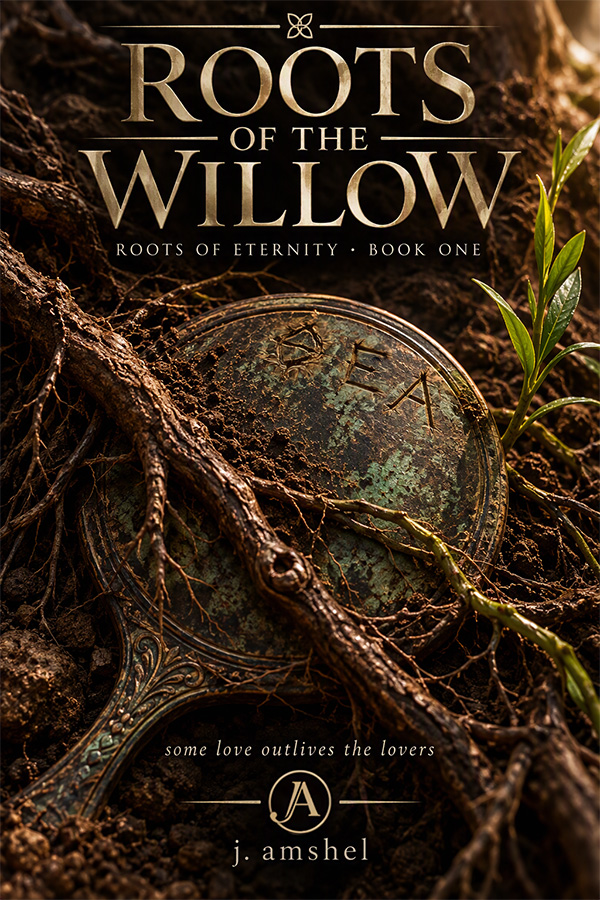
Roots of Eternity, book 1
Roots of the Willow
Current Edit
Before love can reach Eternity, it must find the Roots that bind it.
In 2029, a woman will stand before a bronze mirror in a museum and recognize her name carved into its back. The story of how that name got there begins in 247 CE.
Theoniki is a priestess being delivered to an arranged marriage. Axsain is the horse-archer paid to see that she arrives. Both women belong to a world that has already decided what they owe, what they are worth, and what their futures will cost.
Then war begins erasing the road behind them.
Beneath an ancient willow, they will finally choose for themselves and make a promise meant to survive everything that comes after.
One: Borrowed Year
Tanais
Temple of Aphrodite-Ourania
247 CE
Theoniki sat in the stone shadows of the temple, the mid-morning sun of her final weeks striking the threshold. The air inside the sanctuary was filled with the smell of scorched tallow and river mint, the grease of ancient sacrifices clinging to the limestone walls.
Before her, a woman of the town knelt. The woman was old, her skin the color of river clay, her ears heavy with the copper coils of the steppe. She had brought two young crows with their necks wrung, black feathers dull in the basket beside the altar.
She dipped her fingers into the stone bowl of hemp oil. The grease was thick, carrying the green smell of the marshes. She pressed her fingertips against the old woman’s temples. The skin there was dry as parchment, the blood pulsing in an erratic leap between finger and bone.
“The mother of the grass hears you,” Thea murmured, her voice cold with the repetition of the liturgy. “The queen of the sky holds your house.”
She drew her thumbs down, leaving two dark, shining tracks across the old woman’s cheeks. Under the rules of her sacred year, her touch was law. She was a vessel loaned to the altar by her father’s house, and for these twelve months, her word was the goddess’s own breath.
The old woman closed her eyes. Reaching out, she touched the hem of Thea’s saffron wool tunic, her rough hand lingering on the dyed border before her forehead met the cold floor. No words passed her lips. She gathered her empty basket, laid the dead crows by their feet on the grease-stained limestone, and slipped into the bright glare of the port.
Before the quiet could fully settle, a second worshiper broke the sunlight at the door. He was a man of the lower town, his identity split clearly across his clothes; wearing a fine Greek mantle over linen trousers patterned in the style of the horse-clans, his beard trimmed short after the fashion of the harbor clerks, but his wrists heavy with native iron rings.
He bypassed the white marble frontage where the soft, Hellenic features of the heavenly queen looked out. Instead, his eyes went straight to the dark, twin-faced pillar behind it, where the older, fiercer lines of Argimpasa were cut into the limestone.
He laid a small, greasy leather pouch of horse-tallow on the dais and threw himself flat, whispering a frantic prayer that mashed Greek words with the hard, clicking sounds of the steppe, begging the beast-mother for a blood-right and a fast horse on his next trek. Thea reached for the hemp oil, but the man waved her off with a blunt, scarred finger; he wanted none of Aphrodite’s pristine blessings, only the shadow of the older goddess.
She sighed, but pulled her small iron knife. He leaned forward, and she carved the three lines just above his left eye. “May she who rules the wind show you the path through the blood.”
He pressed his forehead once more to the cold stone before scrambling back out toward the wharves.
She knelt to wipe the small blood on the floor away.
A shadow fell over her. Melitta came in, her sandals clicking against the limestone with a quick, rhythmic beat. She looked back toward the threshold where the man had just vanished, her broad face pulling into a sharp, curdled frown before she managed to find her posture.
“Civilized barbarians,” Melitta muttered, dusting a stray smudge of horse-tallow from the altar rail with an irritated flick of her wrist. “They want the wrong part of her, always. They come into the precinct with their Greek ledgers and their clean-shaven chins, but the moment the wind turns, they’re crawling to the back of the pillar to beg the beast-mother for blood and grass.”
Thea looked down from her stool. “The goddess has two faces, Melitta. You taught me the braid yourself.”
“The braid is for keeping the peace in the lower town, child, not for inviting the marsh mud onto our clean floors,” Melitta said, adjusting the heavy, dark wool at her shoulder.
As she raised her arm, the morning light caught a thick glint of metal on her forearm. Thea pointed. “Your armband is new. That is a Sarmatian twist, isn’t it? The ironsmiths by the harbor don’t make lines that sharp.”
Melitta’s broad face flushed slightly, her fingers instinctively dropping to cover the heavy, twinned iron wire wrapping her wrist. “It is a useful thing,” she defended quickly, the keys of power dangling from the thick bronze ring at her hip giving a sharp clink. “Nothing more. The sleeves of these permanent robes are far too loose; it keeps the wool back and clear of the grease when we have to handle the sacrifices. A priestess can’t have five cubits of fine weave trailing through the offal.”
She cleared her throat, her face splitting once more into a wide, white smile as she shook off the distraction. “But enough of the lower town’s fashion. He has signed,” Melitta said. She came close, the smell of honey-water and garlic following her. “The contract is sealed, Thea. The messenger from Panticapaeum reached the harbor gate an hour ago.”
Thea remained on her wooden stool, her thumbs still greasy. The vacancy behind her collarbone, that cold socket that had never been filled, seemed to open like a crack in dry clay.
“The date is set?” she asked.
“The first day of the planting moon,” Melitta said, her smile widening. She reached out and took Thea’s hands, ignoring the hemp oil. “Your father has done well. Six wagons of salt fish and forty hides of steppe cattle for the escort. You will ride when the winter warms.”
She looked at Melitta’s fingers, plump and white. Forty years of temple life had soft-steeped them. This sanctuary was the only home Melitta would ever know; her authority was not a lease. Built into the very stonework, she could no longer see the bars of her cage.
“Three moons? Four? Till I am sold.” Her voice was sharp at the wrong person.
She stood up. The movement was slow, deliberate. She did not wipe her fingers. Letting the thick marsh oil remain on her skin, she watched it dry under the thin ray of morning light that cut through the roof hole. A slow step took her up onto the low limestone dais, placing her back to the twin-faced image of Ourania-Argimpasa. From there, she looked down. Her saffron wool skirt pooled around her ankles, heavy with the weight of the gold threads her father had paid to weave into the hem.
For a moment, she was not a girl of nineteen who had been bargained away over dried fish and cattle hides. She was the voice of the queen of the sky.
“Did you ever think of it, Melitta?” Thea asked. Her voice was too quiet for the tall stone room, yet it did not shake. “Did you, ever once, consider what it means to give up your own authority? To be unclasped from this altar and sold off like a cheap brass torq in the harbor market?”
Melitta went still. The wide, white smile on her broad face did not vanish so much as it curdled, her eyebrows drawing together in honest bewilderment. Her fingers, still holding grease from Thea’s hands, went slack.
“Sold?” Melitta repeated. The bronze keys at her hip gave a small, nervous clink as she shifted her weight. “What a dark thing to say. You are not being sold, child. And certainly not for cheap.”
She stepped closer, her dark wool robe brushing the edge of the dais. She looked up at Thea, her face soft with a maternal, uncomprehending pity.
“The deal was very favorable,” Melitta whispered. “Your father did not throw you to some tavern-keeper at the harbor mouth. He has bought you the greatest house on the strait. Word of your true worth must have reached the merchant lord’s ear in Panticapaeum. He knows what you are. You will be a treasure to him, Thea. A prized wife.”
Thea looked past Melitta’s shoulder, out through the stone doorway where the salt wind from the harbor brought the shouts of the sailors and the creak of the wooden cranes.
“I know,” Thea said. She folded her hands over her belly. “But a treasure is a thing you keep in a sealed room. Something to impress people with and put away after you use it.”
Melitta did not answer for a long moment. She stood with her arms crossed, her bronze keys resting against the dark wool of her thigh. Her eyes, usually so sharp when counting oil jars or checking weights of the tribute coin, went soft and blank. To a woman who had spent forty years inside three feet of limestone, a sealed room was not a prison. It was the world. It was the only place where the steppe wind could not reach to dry the skin, where the riders from the north could not bring their horses and their iron. Thea saw the moment she lost her argument with the wall.
“You’ve a twisted way of looking at safety,” Melitta said. She reached into her sash and pulled out a clean linen rag, offering it with a small nudge of her hand. “The hemp oil is sinking into your knuckles. Clean them before the sun dries the grease. It’ll leave a green stain on the saffron.”
Thea took the rag. The linen was rough, smelling of the lye-water from the laundry-troughs at the back of the precinct. She began to rub her fingers, her skin turning red under the rough drag of the coarse weave. The oil came away in dark, greasy streaks, but the green smell of the marshes remained. It was in her skin now, deep in the pores, a scent she had carried for twelve months and would leave behind in the dirt of Tanais within four months.
“My father didn’t look at safety when he bought this year,” Thea said. Her voice was hard, her thumbs working the linen into the crevices of her nails. “He looked at the price of grain in Phanagoria. The harbor tax on salt fish was his only measure. He wanted the city to see his daughter on the dais, untouched and high, so the merchant lord on the strait would know exactly what he was buying.”
“That’s a daughter’s talk,” Melitta said. Turning back to the altar with a quick click of her sandals, she bent to lift the dead crows by their legs. Pity was a feeling she had outgrown forty years ago; she had handled hundreds of birds. She swung them into a small wicker bin beneath the sacrificial table. “Your father is a practical man. He has to be. The harbor is half-empty this season. Have you not seen the docks from your window? The ships from Pontus are fewer. The granaries are full because the buyers aren’t coming down the river.”
Thea stopped rubbing her hands. She looked at the old woman’s crows in the bin. Their black feathers were already stiffening, the small, curved beaks parted in a final, silent cry. “He got a bad price.”
Melitta paused, her hand hovering over the wicker bin. “What?”
“The empty docks,” Thea said. She threw the linen rag onto the wooden stool. “The ships aren’t coming because the grain is rotting in the fields or the taxes have climbed too high. He got a bad price for the harvest, Melitta. He’s desperate to clear me off his books before the merchant lords in Panticapaeum find someone with a cheaper dowry.”
“That is nonsense,” Melitta said, her tone sharpening as she dusted her palms against her dark robe. “Your father is the richest man in the lower town. He doesn’t panic over a few empty berths. The buyers stay in the south because the harbor fees here are high. That’s all. Your father knows the wind is turning. He wants you in Panticapaeum because the walls there are twenty cubits thick. They’ve stone towers that look out over the water, and the king’s own guard rides the harbor-moles. Here, we’ve three leagues of rotten timber and some mud-ramparts that the spring rains wash into the marsh.”
“He’s not sending me to a husband,” Thea said. It was not a question. “He’s settling a debt, and I’m the coin.”
“Of course he is sending you to a husband. Who here is worthy of you?” Melitta said, her keys clinking as she stepped back to the dais. She reached out, her fingers catching the golden thread woven into the hem of Thea’s saffron skirt, lifting it slightly to inspect the work. “This gold came from the Bosporan workshops. It doesn’t tarnish. He had the weavers in the lower town work it into the wool so you would enter Panticapaeum looking like a queen. His love for you is real, child. He has spent his life piling up the coin to make this road smooth for you.”
Thea looked down at the priestess’s hand on her skirt. It was white and soft, the skin around the nails tidy. Melitta had never known the drag of a water-bucket or the grease of a sheep-shearing. Her life was clean, measured out in the drips of the temple water-clock and the steady arrival of the town’s small worries. To Melitta, a daughter’s wedding was simply another tribute paid to the order of things, a necessary grain-offering laid upon the great altar of the house.
“I saw one of the steppe women in the square yesterday. She looked like some starving vagrant who had ridden three days to beg for grain, her eyes red from the dust, her hand never moving from her iron because she’s afraid someone will steal her horse.”
“They’re barbarians,” Melitta said, her voice rising slightly, defensive. “They live in the saddle. They don’t sleep in beds, Thea. Of course she was dirty. The ones that live in the walls are hardly better.”
“She was staring at the market gates,” Thea said. “Even while she watered her beast, her face was turned toward the pens. The temple did not interest her, nor did the city’s wealth. She was counting the sheep, Melitta. The wolf was looking at the sheepfold, waiting for the winter to turn hard.”
Thea walked to the temple threshold. She stopped just where the shadow met the sun, her toes touching the white line of the limestone sill. The harbor below was a tangle of masts and grey roofs, the water of the Maeotian sea dull and flat under the summer haze. Beyond the harbor, the grass began. It ran north and east, a grey-green ocean with no end, its surface rippling in the hot wind like a horse’s skin.
“I don’t want to go,” Thea said. Her shoulders sank, her head dropping forward until her chin nearly touched the collarbone where the cold vacancy sat. “I want to stay here. I want the year to keep going. I want to clean the grease from the stone and listen to the old women tell their stories about the crows. I don’t want the winter moon to set.”
Melitta stared at her. She stood in the center of the dim room, her dark robe making her look like a piece of the wall had detached itself. Her face was a mask of confusion, her mouth slightly open. She had spent her entire life serving the braided goddess, accepting each turn of the season as a holy law, and she could not understand why a girl with a golden hem and a palace waiting on the strait would want to keep her feet in the mud of Tanais.
“The goddess doesn’t halt the moon for anyone, child,” Melitta said, her voice gentle but empty of comfort. “The year is finished. The bride price is set. You must go to your house.”
“My house is here,” Thea said, but she knew it was a lie. Her house was fifty bushels of wheat and three silver cups, and the trade had already been made. She looked out at the empty sea, her heart cold and gray in her chest.
Melitta watched her from the shadows, her fingers twisting the bronze keys on her hip, her face dark with the quiet frustration of a woman who had never known what it was to have a world to lose.
Two: Hard Rider
Axsain leaned over her mare’s neck, the wind of the high noon steppe biting her face as she circled the low leather tents. She had done this three times since the sun hit its peak. Her thighs clamped the horse’s ribs. She reached back. Her fingers found the nock of the third shaft without looking. The bow was horn and sinew, stiff from the salt air, but she bent it anyway. She drew the cord to her cheek, her eye tracing the line between her horse’s ears.
A child scrambled across the dirt forty paces ahead, chasing a stray dog. Axsain did not check her mount. She loosed the string. The shaft flew over the boy’s wool cap and splintered the wooden bullseye nailed to the central water cart.
Another target waited by the horse-lines, a dried sheep skull on a lance. Axsain lunged low, her stirrups rattling. She notched her last arrow. Her shoulders ached from the pull. The mare veered left of a cooking trench. Axsain drew, the horn of the bow warm against her knuckle. She aimed for the skull’s eye. She released.
A shadow burst from the gap between two felt tents. A heavy weight struck her ribs, hard and cold. Her breath left her in a wet grunt as she was swept from the wooden saddle. The sky spun. She hit the packed dirt with a thud that shook her teeth, the horse’s hooves drumming away into the grass. She rolled, her skin scraping the gravel, her hands clawing for any grip.
The mass of the body over her was thick, smelling of horse-grease and raw onion. Gravity pinned her chest. Her ribs burned with a sudden heat. She slid through the dry dust, her boots digging for purchase in the shifting earth. She slipped the grip and flipped the mass.
Axsain did not wait to see his face. Her hand dropped to the leather sash at her hip, fingers closing on the turned-wood handle she kept tucked beneath her belt. She yanked it free. The heavy ash shaft was polished smooth, tipped with a massive, carved bulb.
She swung it with both hands. The wood cracked against his shoulder. He yelled, throwing his arms up to guard his face. She struck him again, a hard, downward blow that clipped his ear.
“Stop!” he shouted, his voice cracking with a laugh as he rolled onto his side to escape the club’s reach. “Axi, by the hearth-fire, stop!”
She lowered the club, her chest heaving, the hot air thick in her throat. Her knuckles were white around the grooved handle. She spat a mouthful of grey dirt onto the grass.
Kazas sat up, rubbing his red ear. A grin split his broad, scarred mouth, though he winced when he touched the swelling skin. His eyes did not look at her face; they fixed on the carved ash rod in her hand.
“You’re going to break the wood,” Kazas said. He blew a speck of dirt off his knuckles. “That’s fine ash. It took me three nights to carve.”
“You jump me from the dark like a Siraces scout,” she said, her voice shaking with the heat in her chest. “Next time I’ll use the iron.”
“You wouldn’t have the iron if I hadn’t traded my winter furs for it,” Kazas said. He reached out, his thumb tracing the thick, rounded tip of the phallus. “Besides, that’s not why I gave you the token.”
“It’s not to beat sense into idiots?” she said, her thumb running along the shaft as she pulled it away from him.
“You’re supposed to tuck it down your breeches,” Kazas said, his voice dropping as he looked at her hips. “When we ride into the skirmish. It’s supposed to give you the weight. To make you feel like a man among the horsemen.”
Axsain looked down at the carved wood, then at his grin. She let the heavy end drop against his knee with a quiet thunk.
“Beating a man with a wooden cock,” she said, her voice lined with absolute certainty, “makes me feel like a woman. Which is what I am. Besides, I’ve seen the men of the clan in the river, washing. This,” she touched his nose with the wooden bulb. “Is twice what makes you a man. Why don’t you carry it?”
He laughed again, shaking his head as he scrambled back to his feet. “You’re a mad thing, Axi. I just came to tell you food is ready. Hurry, or the men will eat it all.”
He turned and sauntered back toward the leather tents, his broad shoulders shaking at his own joke.
Axsain watched him go. The heat in her face slowly cooled, replaced by the dry, salt-tinged breeze from the Maeotian marsh. She slipped the wooden phallus back under her leather belt, the cold wood pressing against her hip.
Her hand drifted to her wool vest. Underneath the heavy horsehide protector, tucked into a small pocket of soft deer-skin, sat the bronze disc. Her fingers closed around the hard, circular rim. She did not pull it out.
She did not need to look at it to know the face was dead, unpolished, waiting for the blood that would buy her the right to clean it. To everyone who looked at her in the camp, she was the girl who rode like a hawk and drew the heavy horn bow. To herself, she was simply a debtor whose account remained open.
A high, thin whistle cut through the dry air. Nara, a slip of a thing with her hair braided in the clan’s greasy leather style, came walking between the carts, leading the grey mare by its halter. The child’s tunic was three sizes too large, the hem caked with dried mud from the riverbank.
She stopped before Axsain, holding out the lead rope. Her face was dark from the sun, her upper lip smudged with soot from the cooking-pits.
“She didn’t run far,” Nara said, her voice small but tough. “She stopped by the water-skin wagon to steal some oats.”
Axsain took the leather strap. She patted the mare’s damp shoulder, feeling the muscle quiver under the hide.
“Good girl. Did you see where the arrows struck?”
Nara nodded, her black eyes wide as she looked at the bow still in Axsain’s grip. “They’re right in the wood and bone. Even the one over the water-cart. I tried with my brother’s small horn-bow this morning, but the cord hit my wrist. I could not reach the target at the far end of the sheep-pens.”
The child stepped closer, her hand rising to touch the smooth curve of Axsain’s bow-stave. “How do I get as fast as you, Axi? My mother says I have to practice the bow until my fingers bleed, but my hands are too soft. The bone doesn’t bend.”
Axsain sat down on the tongue of a parked baggage-wagon, the wood dry and splintered against her leather trousers. She laid her bow across her knees. Nara watched every movement, her breath still under her wool shirt, her feet bare in the dirt.
“Your fingers are soft because you’re seven,” Axsain said. She did not soften her voice, nor did she offer a pat on the head. “The horn-bow is a stubborn thing. It doesn’t care about your hands. It only answers to the weight of your back.”
Nara sat in the dirt, her knees pulled to her chin. “My mother wants me to start working the wool-combs next season. She says the horsemen don’t want a wife who spends her days in the grass looking for lost arrows.”
Axsain reached down, her rough fingers catching the girl’s chin, turning her face toward the wide, empty steppe beyond the wagons. The grass ran out to the sky, a vast, pale green sea that seemed to swallow the horizon.
“Your mother wants you alive,” Axsain said. “And she wants a herd that doesn’t wander off. In the tents, there’s always a fire and a pot of stew. It’s warm. The wind doesn’t eat your skin.”
“Do you want that?” Nara asked, squinting against the glare of the noon sun.
Axsain looked past the horse-lines toward the southern horizon, where the harbor of Tanais met the grey salt flats of the marsh. Her fingers stayed loose on the wood of her bow-stave.
“I’ve been in the town,” Axsain said, her voice dropping into a low, steady gravel. “Behind that blank wall. I’ve seen what happens when every woman stays by the fire. They’re property there, Nara. Nothing more than sheep, bought and sold in the market by men who count their teeth like cattle.”
The child stared at her, her bare toes digging into the grey dust.
“But the Allon of our blood are different,” Axsain said, her eyes locking onto Nara’s. “We need women at the fire, and we need women on the horse. You’re seven. Do both to find your place, then hold to it.”
Nara drew back, her small chest rising as she swallowed the weight of the words. She looked from Axsain’s dark eyes to the heavy bow, then down at her own soft, dirty fingers.
“Work the wool-combs,” Axsain said, her hand pushing the child’s soft face away. “Keep your skin soft while you can. But when the men are asleep, you take your brother’s bow. You go to the horse lines and pull the cord until the horn remembers your shoulder. Pull it so that when the Siraces come down the river, you can hit a head at sixty paces.”
She stood up, checking the mare’s girth with a quick, hard jerk of her hand. “Now go help your mother with the tallow. The grease won’t boil itself.”
Nara scrambled up, her bare feet kicking up two spurts of grey dust as she ran back toward the tents, her head low, her braids swinging against her back.
Axsain watched her go. A quick swing took her into the wooden saddle, her thighs gripping the mare’s ribs once more. The wind from the marsh had turned, carrying the cold, sour smell of the low water. She turned the mare to the horse line when she saw him.
The low thud of hooves announced Saurym as he rode in from the town track. The clan leader was all smiles, his grey-threaded braids swinging against his wool vest as he returned from trading for supplies. The smug line of his jaw told her he had done far better than bartering away their few remaining pelts for another week or two of grain.
He pulled his horse up beside her mare, the beast kicking up a brief swirl of dust.
“We eat through the freeze, Axi,” Saurym said, his voice a warm, dry rumble. “I’ve traded four weeks of our time for a winter’s worth of food.”
Axsain did not shift her gaze from the southern horizon, though her thighs tightened against her mare’s ribs. “At least we have time to trade. What are we doing?”
“One of the oil-dripping harbor traders wants his daughter taken to Panticapaeum before winter freezes the road.”
“A month’s crawl down the rim isn’t worth a winter’s supply of grain and salt-pork, Saurym. The Yauna don’t empty their warehouses for a ride to another town.”
“The trip is not,” Saurym agreed, a slow grin spreading beneath his grey mustache. “But you are worth that much. The man is frantic. He wants you at his daughter’s side the entire way —a woman who fights, holding the door, keeping her pure for the man in the city she will wed.”
He wheeled his mount back toward the central leather tents to call the drivers to the lines, leaving his laughter behind in the cold wind.
Axsain stayed motionless in the saddle, her fingers lingering near the horn grip of her bow. A girl from behind a wall, wrapped in gold and locked away like a lamb waiting for dinner. And she had to watch the lamb to ensure it was not stained on the road. She gripped the bow, then let it go, her fingers finding the dead disc through the deerskin. The unpolished mirror waiting for the stain she was owed.
Three: Testing
Axsain leaned against a stack of salted bull hides in Phormion’s wharf-side warehouse, watching the noon light leak through the cedar roof slats. The air inside smelled of rotting fish-heads, damp wool, and the sharp grease of her own leather vest. Across the cedar table, Phormion sat with his hands spread flat on the wood. He was a thick-necked Yauna whose blue tunic was stiff with Phanagorian embroidery, but his fingernails were gray with dock-dirt. He had spent the morning grumbling about harbor taxes, but his hurry was real; she could smell the cold panic under his sweat.
Saurym sat opposite him. His hard eyes, used to tracking movement on the grass sea, were locked on the two garrison guards standing at the merchant’s back. He did not spare a glance for the small heap of silver coins Phormion had piled between them.
The guards were heavy men, broad-shouldered and grease-skinned under their green-crested helmets. Their bronze breastplates had been polished until they shone like river stones, but they had the soft, thick bellies of men who ate porridge by a tavern fire every day. They held their heavy ash spears with the lazy grip of men who had never chased a horse-archer across the dry grass.
“You’re getting double,” Phormion said, his voice precise with the dry habit of the market. “Double what the harbor captain wanted for four of his best pikemen. And you’re giving me a girl with horse manure on her boots to guard my daughter’s tent door. Is she even twenty winters?”
He wanted a woman at that door to keep his precious cargo untouched, but he did not want to pay the price for the iron that came with her. A daughter was a gift for someone else to be kept in a guarded camp, and a ruined asset was worth nothing to the merchant lords of Panticapaeum.
“I have enough years to stand the line. And my boots are clean,” Axsain said. She did not raise her voice. She simply tapped the heavy ash rod she had tucked beneath her leather belt. “The horse-manure is on the road, where your city-soldiers will be crying for their mothers after two nights in the dew.”
Phormion’s gaze slid to her, his brow drawing into a hard bunch of lines. He looked her up and down, his eyes lingering on her lean shoulders and the dark, wind-burned skin of her neck. To him, she was nothing more than an accounting error, a costly piece of barbarian salvage he had been forced to buy.
“She’s small,” Phormion said, turning back to Saurym. “My daughter’s handmaids are larger than this. If the Siraces come down the river, how do I know she doesn’t run? I need assurances that she can hold a blade against a real man.”
He gestured to the guard on his right, a square-jawed Yauna with a scar running through his sparse beard. “Lysandros here spent three seasons on the grain-boats. He’s broken the ribs of four river-pirates with his bare hands. Tell me what your clan-woman does when someone like him decides to take what is mine.”
Saurym let out a slow, dry breath, his fingers tracing the rim of his clay cup. “Do you care if we break them?”
Phormion blinked, his thick mouth parted. “What?”
“Your guards,” Saurym said. “If she fights one, and his arm is no longer good for holding a spear, do you deduct his wages from our silver?”
The two garrison guards exchanged a quick look, their heavy shoulders shaking with a silent, heavy mirth. Lysandros let out a short, barked laugh that smelled of garlic and thin wine.
“The barbarian thinks his girl can bend bronze,” Lysandros said, his hand resting on the pommel of his short iron sword. He stepped forward, his leather kilt slapping against his thick thighs. “The little mare would snap her wrists if she tried to lift my shield.”
Phormion’s mouth twisted into a dry grin, his hand coming down on the silver coins with a soft clink. “No woman of the tents can harm either one of them, Saurym. They’re Tanais men. They’ve got iron in their veins, not mare’s milk.”
Beside Saurym, Sargis stood up. He had been quiet until now, his lean, scarred bow-arm resting on the hilt of his short-sword, his dark eyes fixed on the warehouse rafters. He was the band’s second, Axsain’s brother, and his voice when he spoke had the flat, hard scrape of a whetstone.
“If you trust that,” Sargis said, “then she can fight them both.”
Phormion did not waste time. He barked an order to three of his cargo-haulers, pointing at a stack of barley sacks near the rear wall. The men moved fast, dragging the heavy hemp bundles back until the packed clay floor was clear, leaving a fifteen-foot ring in the center of the warehouse. The air grew thick with grain-dust that danced in the yellow shafts of light.
Sargis caught Axsain’s shoulder before she stepped out. His grip was broad and dry, smelling of horse-tallow. He leaned down, his voice a low rattle near her ear. “Don’t kill them, Axi. The merchant won’t pay if he has to buy two new coffins before we even reach the gate.”
Axsain looked past his shoulder at the two Yauna. Lysandros was already unbuckling his bronze breastplate, letting it drop to a barley sack with a heavy, hollow clang. The other guard was taller, with a broken nose that had healed crooked. They looked like two fat bulls waiting for a gate to open. “I’ll try not to,” she said. Her fingers slid into the small leather pouch at her hip, brushing past the cold edge of her bronze mirror to scoop a handful of dry, river-grit sand she kept for fights and pan washing. She kept her palm closed.
The Yauna stepped into the cleared ring, their ash spears leaning against the cedar pillars behind them. They moved with their chests pushed out, their arms spread wider than their smiles. To them, she was a small, dusty nomad girl whose wrists would snap at her first strike. Lysandros gestured with two fingers, inviting her in. “Come on, little mare. Let’s see if you buck.”
Axsain walked straight at them. No circle. No show. The town-fighters bounced on their toes in the cleared ring, all chest and swagger, but she kept her weight low, balanced, quiet. Her leather boots made no sound on the packed clay.
The tall guard with the broken nose stepped left. His hand came out, lazy, wide, reaching for her hair. His fingers twitched. Axsain moved. One flick of her wrist, sharp and mean, and the river-grit snapped up in a hard gray spray. It hit Lysandros square in the eyes before he could blink. He roared, choked on it, hands flying to his face as he staggered back.
Axsain never looked at him. The tall guard was already reaching. She dropped under his arm, tight, chin tucked, and drove her shoulder into his ribs. Air left him in a wet grunt. Her fingers locked around his wrist, hard as an iron hoop. He tried to pull free. She twisted down, back, turned her hip across his stride, caught his rush, used it. His own weight did the rest. He went over her side and hit the floor with a hard, hollow thud. Every breath in the warehouse stopped. Before he could roll, her heel drove into his collarbone, and she wrenched the trapped wrist up.
The shoulder gave. Wet. Heavy. A pop that cut through the room. The Yauna shrieked, high and thin, his face going gray against the dirt.
Axsain let go. The tall man’s arm dropped, loose, useless, a dead branch against his ribs. She turned to Phormion. One step. Then another. Her boots passed over the groaning man on the floor.
The merchant’s face had gone the color of salt-pork.
“Does the one clawing his eyes have children?” she asked. Flat. Cold. No anger in it. No pride. Only the question.
Phormion stared. His lips parted in a blank circle. He looked from his writhing guard to Axsain’s dirt-streaked face, back again, trying to find the ledger-line for this. “Lysandros? He—his wife has not taken yet.”
Axsain’s hips shifted. The kick was there, loaded, waiting. Then she let it die. She walked past Lysandros while he rubbed at his ruined eyes, wiped her dusty palm on her trousers, and went to Sargis by the cedar pillar. She did not look back.
The warehouse remembered how to breathe. Grain-haulers shifted back into the shadows. Lysandros blinked red tears into the dirt. The tall guard hugged his dead arm and made small, broken sounds through his teeth. Saurym did not move from his stool. He looked down at his silver, then up at Phormion’s frozen face, a slow, dry grin spreading under his grey mustache.
“Your daughter will find no safer hands than Axi to travel in,” he said.
Phormion’s wide eyes went from the broken guards to Axsain, where she stood near the pillar, arms crossed, mouth a line. His eyes hardened. “She will do. Take your coin. I will bring your cargo tonight. Leave at the break of day. Glauke,” he gestured to an old Yauna woman in the corner, “will hold my daughter’s purity, while your...” He looked at Axsain. “...woman who fights, holds the door.”
Four: Freedom’s Edge
Thea stood on the cedar balcony overlooking the dusty lane behind her father’s warehouse as the midday sun began its long descent. Below, the tall double doors creaked open, spilling the sharp smell of salted hides and old grease into the harbor wind. Three figures stepped out into the light. First came a large, older man, his grey-threaded braids shifting across his wool vest like weathered ropes. Behind him walked a younger man, his hand resting loose on his short sword. But it was not the men who kept Thea’s eye. It was the woman.
The barbarian walked with a low, flat stride that ignored the muck of the alley. She was not small, though her shoulders were lean under the heavy horsehide protector. Her hair, dark and twisted into thick yarn, was held with bronze bands, and her eyes looked red from the steppe dust. A bow of horn and sinew was slung across her back, the bone polished until it caught the glare of the day.
Weapons hung from her leather belt with an easy, unthinking familiarity. As she moved, her short wool vest shifted, revealing a thick rod of turned wood tucked beneath the leather sash at her hip, pale and blunt and wrong somehow beside the bow, and Thea could not think what it was for.
She did not walk like the women of the lower town who scurried from porch to porch, nor did she have the wide, sluggish waddle of the garrison guards. This woman moved like she owned the earth she trod.
The servants by the well had gossiped about her people, the Alans of the deep grass sea, and the stories had reached the temple. Thea knew the rumors. They said the steppe women could not marry until they had killed a man in the open field. They had to take a life before they could claim their own. Thea was an asset moved from one line to another in her father’s ledger. The barbarian had a bow, and her iron, and she was looking for blood so she could choose a husband.
The weight of that choice rocked Thea’s ribs. She stood frozen, watching the tall woman adjust the horsehide strap of her quiver, following the long fingers as they slid down the leather.
To have a choice. Even if she chose the temple and its greasy limestone altar, or the dark warehouse with its stacks of rotting fish, the decision would be her own. The choice would not be her father’s, and it would not be a husband’s.
A quick, familiar scuffle of sandals on the cedar floorboards broke her thoughts. Melitta stepped out onto the balcony. Her keys clinked as she leaned against the railing, her round face flushed with the dry harbor heat.
“We must move,” Melitta said, her breath smelling of honey-water and garlic. “Your father’s old woman, Glauke, came from the warehouse. She told me the deal is locked. The horse-archers have taken the silver, and the wagons are to move at dawn. You leave in the morning, child. Hira is already loading your chests.”
Thea whipped around, her fingers losing their grip on the cedar rail. “In the morning? Melitta, no. I thought I had months left here. I thought the year at the altar was mine. Now I only have the day?”
Melitta sighed, adjusting the heavy bronze ring at her hip. “Your father found a faster way, child. A safer way, and far cheaper. The Alans are moving down the sea anyway, returning to their winter grounds, so he realized he could hire their whole band for a fraction of what the city guard demanded. And they have a warrior woman among them, a real barbarian who carries a bow and rides like a man. Your father insisted on it so you would have a woman at your tent every night of the road, keeping his precious cargo untouched.”
Thea pushed back, her jaw tightening as she looked toward the dust of the lane. “To be thrown to horse-archers like grain cleared from a ledger? He is cutting corners, Melitta.” She paused, a sudden realization catching in her throat as she turned back to the priestess. “The woman who just walked out of the warehouse doors...the one with the horn-bow slung across her back. Is she the one?”
Melitta nodded, dusting her palms against her dark robe. “Yes, the very one. The whole pack lives in their saddles. Though why your father paid double for that wild girl to sit at your tent-flap, I’ll never understand. She belongs in the grass.”
Thea turned her head slowly, her eyes finding the priestess’s soft, white face. “Is it true, Melitta?”
“Is what true?”
“The story,” Thea said, her fingers tightening on the cedar rail until the rough wood bit into her skin. “The ones the traders by the harbor tell. Does she...does an Alan woman warrior have to kill a man before she can marry?”
Melitta let out a short, dry laugh, her hand dropping to her keys. “Oh, the old legends. You’ve been listening to the sailors again. They always make those steppe-born things sound like monsters.” She leaned closer, her eyes bright with the confidence of a woman who had never stepped beyond the mud-ramparts. “But there’s truth in it, child. A long, hard truth.”
Her voice dropped to a conspiratorial murmur. “It’s a blood-debt. By their law, if a woman takes the saddle instead of the cook fire, she is simply a maiden until she has ridden into the field and taken a life. She must slay an enemy with her own hand. Some say she must kill three men before she is permitted to touch a husband’s bed. If she fails, she dies unmarried. A dry leaf blown across the grass.”
Thea’s heart gave a slow, heavy thud against her ribs. Three men. A life paid for by lives.
“Three men, then she is free to...what?” Thea asked.
“If she kills, then she chooses,” Melitta said, her lips curling. “She takes the blood of the last man she slew, smears it across her fingers, and marks her chosen husband’s brow. He must take her then. He has no say, no choice of his own. The blood-mark binds him.”
He has no say. She could almost see it. The barbarian woman, her fingers dripping with red as she pressed them to a man’s forehead. A choice bought in blood. A husband claimed like prey.
“But that’s not the worst of it,” Melitta continued, her voice sharpening with a shudder that did not quite hide her relish. “They’re savages, Thea. To make sure the bow pulls true and the draw sits flat against the ribs, their mothers take a hot bronze iron to them. When they’re babies, still at the teat. They sear the right breast off, burning the flesh away so the bone grows naked and the horn-bow has no hindrance.”
Thea’s hand rose instinctively to her own chest, her fingers curling over the soft curve of her saffron tunic. The skin beneath went suddenly cold, as if the bronze iron were hovering near her flesh.
“They burn them?” she whispered. “Why just...the one?”
“Sere them to the bone,” Melitta said, nodding with absolute certainty. “For if they wed. So a child can suckle still. That’s the freedom you’re looking at, child. A scarred chest, a bloody hand, and half the feed for your babe. They’ve no womanhood left in them but what they buy with a knife. Be glad your father’s silver is sending you to a soft bed in Panticapaeum.”
Thea looked back down at the empty lane, the sun baking the grey dirt into a hard, cracked crust. The image of the tall woman did not fade; it grew heavier, sharper. The seared flesh, the three dead men, the blood on the brow. It was terrifying, a nightmare of iron and fire.
Yet, as she rubbed her unscarred chest, a cold vacancy opened inside her. Even with the hot iron, even with the blood, the barbarian woman had a bow and a horse. Tomorrow she would ride into the grass a warrior, while Thea would sit in a covered wagon, a silent piece of cargo wrapped in gold thread, waiting to be delivered.
“I wonder if she thinks her life was worth all of… that,” Thea said under her breath.