Quillov’s Creations › Cobalt Tomes › Short Stories › Art of Gardening
Book
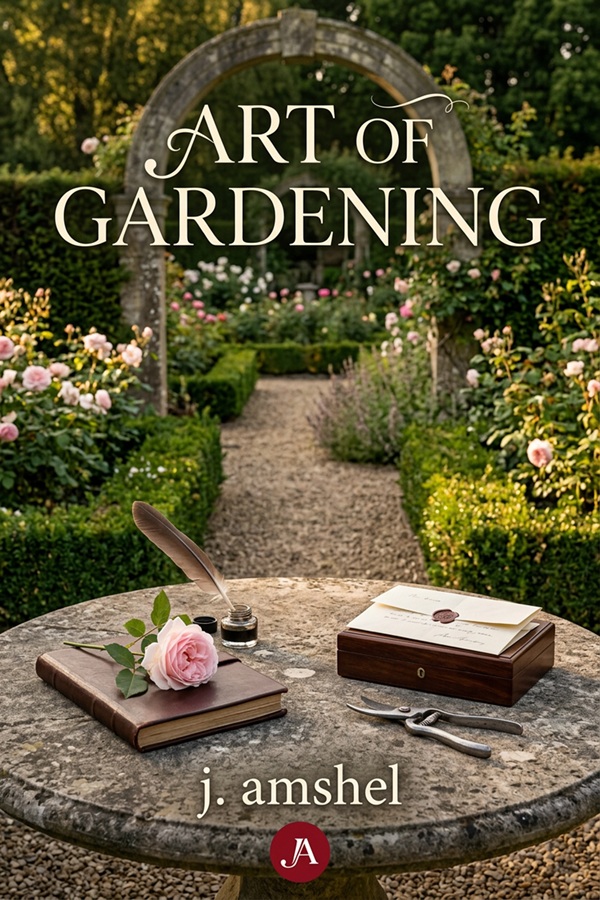
Art of Gardening
First Draft
The eighteenth century was an age of art, science, philosophy, and exploration. Progress was not always evenly distributed.
In the privacy of a journal and a confidential letter, a newly married couple record rather different impressions of the same evening. Art of Gardening is a brief comedy of marriage, discovery, and the considerable distance between enthusiasm and expertise.
Aldous
From the Private Journal of Mr. Aldous Grey
March 12, 1754
Last night I performed my duties as a Man of the Line, for the continuance of the family, and I confess myself changed by the office of it. Elspeth was most accommodating after the long wedding, and I approached her chamber as a pilgrim approaches a shrine long promised him in scripture but never before beheld.
I had imagined, in the manner of the poets I am fond of quoting at supper, that the marriage bed would resemble an orangery: orderly, temperate, each bloom arranged by some unseen hand for the pleasure of the beholder. I was not prepared for the wildness of it. My fingers pressed through a tangled thicket to find warm, damp earth, eager to be tilled, and I own that I trembled, though whether from reverence or terror I could not then say, and cannot now.
It occurred to me, in the midst of my labours, that I had spent two-and-twenty years cultivating the surface of myself, my wit, my wardrobe, the turn of my bow, and had given no thought whatsoever to what lay beneath the dress (the actual dress, and not the metaphor of one) of any woman, my wife included. I found myself a stranger in my own estate. Elspeth guided me, once or twice, with a small adjustment of her hand upon my wrist, gentle as a gardener correcting an apprentice's grip upon the shears, and I was grateful for it, though I said nothing, not wishing to disturb the solemnity of the rite with confession of my ignorance.
As my father did, and his father before him, back four generations, I have now taken up the family's oldest office, and I find myself proud of it in a way I had not anticipated, proud the way a man is proud of a debt honestly paid.
I write this now by candlelight, my wife asleep, and I find I cannot settle my thoughts into their usual elegant rows. There is a garden in every marriage, I begin to suspect, that no amount of reading prepares a man for: sacred, overgrown, and entirely indifferent to the picture he had made of it beforehand — a wilderness I mean to walk again tomorrow night, and each night after, until I know it as well as I believe I do now.
Elspeth
My dearest Helena,
I trust this finds you recovered from the wedding, which I understand from your own account left you with a headache worthy of a physician's attention. Mine was of a different nature entirely, and I write chiefly to thank you for your counsel these past weeks, and for the loan of your instructive little article, which I return to you enclosed, cleaned and wrapped as we discussed, with my deepest and most private gratitude.
It was most instructive — though I confess the illustration was rather larger than what he brought to the bed chamber himself, a fact I shall carry to my grave alongside several others, as must you. I confess that in the moment itself, I found my thoughts returning entirely to your fingers upon mine, the evening you showed me its proper use in your dressing room, patient as any governess, while I laughed until I could scarcely attend the lesson. It was that memory, and not my husband's rather ornate observations on horticulture, that carried me through the evening with my composure intact.
Before, he spoke only of his roses and the espaliered pears, and I listened gladly, for I am fond of the garden myself. After, his talk turned to damp soil and tangled things left too long unweeded, and I understood him to be reaching for some likeness between the two, and began at once to think of anything else at all: your dressing room, the article, the weather. He is, I believe, a kind man, and I do not say this unkindly: he approached the whole affair as though it were a passage from Ovid, requiring only sufficient feeling to be done correctly. I have not the heart to tell him otherwise, nor do I think I shall need to. Men of his temperament tend, in my limited experience, to mistake their own wonder for skill, and I see no profit in correcting an error that costs me so little and spares him so much.
I do wonder, dear Helena, whether you might have some time later this week to refresh my memory on its uses. If you are so inclined, we might also explore the alternative place it may be put to use, of which you spoke so slyly and would not elaborate further at the time. I find myself with an unexpected appetite for further instruction, and can think of no tutor I should prefer to you.
Burn this letter, as ever, and give my love to your mother.
Yours, in the strictest confidence,
Elspeth